The Playground Is a Classroom With Better Hair
A classroom has chairs, whiteboards and the occasional mysterious pencil lodged behind a radiator. A playground has none of these things, yet it teaches a remarkable number of lessons before anyone opens a workbook.
Children practice learning skills throughout the school day when they chase, balance, climb, and negotiate. They judge distance, change their body, detect social signals, and make quick decisions. One child may plot a path across stepping pods while another checks the swing’s availability. Nearby, a small committee decides who goes on the slide.
This is learning with mud on its shoes.
Playground equipment chosen with care gives kids more than something to do during recess. The landscape is full of manageable problems. Without adults watching, kids can test their strength, recover from little mistakes, and try again. A child who has climbed a wall may feel more confident when solving a difficult mathematical issue.
Movement Helps Children Arrive Ready to Learn
Long periods of sitting can make even the most enthusiastic student feel like a folded deck chair. Active play gives the body a chance to wake up properly.
Running boosts heart rate. Climbing requires coordination between arms, legs, and torso. Children modify their posture and adapt to movements when swinging. Many kids return to class calmer after this activity because they released energy in a productive way.
The benefit goes beyond exhausting kids. Helping them self-regulate. Some students need strong activity to focus. Rocking or mild balancing are preferred by others. Children can identify their readiness on a playground with diverse movement experiences.
This matters because children do not all enter the school day with the same energy level. One may arrive buzzing like a phone on silent mode. Another may be cautious, tired or overwhelmed by noise. A varied play space offers several routes into participation rather than demanding that every child enjoy the same activity.
A Good Playground Offers More Than One Kind of Challenge
The best playgrounds do not operate like a one ride theme park. They provide a menu of physical and social experiences.
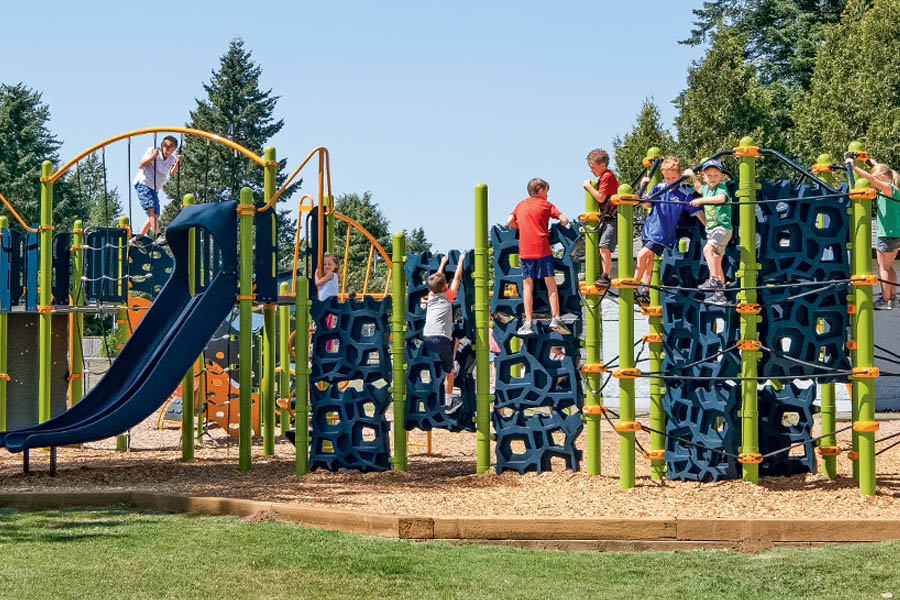
Climbing equipment can offer low platforms for beginners and higher routes for children who want a bigger challenge. Balance features can include broad beams, uneven stepping surfaces and linked pathways. Slides add speed and anticipation, while tunnels create spaces for hiding, crawling and imaginative games. Spinners and rocking features bring a different type of movement, one that can be calming for some children and thrilling for others.
This mixture helps prevent the playground from becoming a daily traffic jam around one popular slide. It also supports progression. A child might begin by walking across a wide balance beam, later try a narrower one and eventually combine it with a jump to the next platform. The equipment becomes a quiet record of growing ability.
Challenge should feel inviting rather than terrifying. Children need room to make choices about how far they want to stretch themselves. If every feature is designed for the bravest climber in the year group, many students will become spectators. If everything is too easy, the playground quickly loses its sparkle.
Play Equipment Builds the Body in Sneaky Ways
Physical development does not always look like formal exercise. Children rarely announce, “I am now improving my shoulder stability.” They simply hang from a bar because it feels exciting.
Climbing develops pulling strength, grip and coordination. Crawling through tunnels strengthens body awareness and encourages children to plan how their limbs fit through a space. Stepping stones and balance paths help refine foot placement and posture. Jumping from a low platform teaches children to bend their knees, absorb impact and land with control.
These small actions build a foundation for other activities. Better balance can help with running games. Stronger hands can support writing and tool use. Improved coordination can make sports, dance and practical classroom tasks feel less frustrating.
There is also an important relationship between movement and spatial awareness. Children learn whether their body can fit under a bar, how much force is needed to push a partner on a rocker and how quickly they need to move when another child enters their path. The playground is full of physics lessons, although nobody has yet needed to label one with a worksheet.
Social Skills Get Their Own Practice Ground
A playground is one of the few places where children must constantly navigate shared space. They learn that a slide has a queue, a swing needs personal space and a group game may require rules that everyone understands.
These moments can be challenging. There may be arguments, dramatic claims of unfairness and negotiations conducted with the seriousness of international diplomacy. Yet these interactions are valuable. Children practise asking to join, waiting for a turn, explaining a rule and repairing a disagreement.
Multi-user equipment is especially useful for cooperative play. Rockers, basket swings and group spinners invite children to coordinate their movements. If one child leans too far or another pushes at the wrong moment, the whole group feels the result. They begin to notice how individual actions affect everyone else.
Creative play provides depth. Before lunch, a climbing structure can be a pirate ship, mountain rescue station, or dragon’s palace. When someone introduces an unexpected dragon, kids assign roles, create stories, and adjust. Flexible play promotes collaboration and problem-solving.
Inclusive Design Makes the Yard Feel Bigger
Inclusion is not achieved by placing one accessible feature in a corner and declaring victory. A genuinely welcoming playground allows children with different abilities, confidence levels and sensory preferences to participate in the same social world.
Mobility devices and groups of youngsters can travel more easily on wide walkways. Transfer points, supportive handholds, and ground-level play can expand activities. Children can rest in quiet locations when the noise and motion get too much. Visual contrast, defined routes, and various textures help kids comprehend playground organization.
Inclusive design benefits everyone. A low-level musical panel may be useful for a child who cannot climb, but it can also become the headquarters of a busy group game. A shaded retreat may help a sensory-sensitive student recover, while another child may use it as a reading nook or secret meeting place.
The goal is not to create separate playgrounds for separate children. It is to create enough choices that more children can play alongside one another without the space feeling like a puzzle with missing pieces.
Smart Layout Prevents Playground Traffic Jams
Even excellent equipment can disappoint if the layout is awkward. A slide that empties directly into a running route is an invitation to collisions. A climbing feature placed beside a high speed game can create confusion. Equipment needs breathing room, clear visibility and sensible connections between activities.
Designers should think about movement as a series of journeys. Where do children enter? Which areas are likely to become busy? Can children move between features without crossing the path of someone using a swing? Are quieter activities located away from the loudest action?
Zones can help organise the space without making it feel rigid. An active area might contain climbing, sliding and running opportunities. A discovery zone could include sand, nature elements or loose parts. A social area might offer group seating and cooperative equipment. Younger children may benefit from a clearly defined section with equipment scaled to their size, while older students may need greater height, speed and complexity.
Good visibility matters too. Staff should be able to scan the yard without needing the climbing skills of a mountain goat.
Maintenance Keeps the Fun From Becoming a Mystery Novel
Playground equipment works hard. It faces weather, enthusiastic use, muddy shoes, snack wrappers and the occasional child determined to test whether a structure can support an entire friendship group.
Regular inspections help identify loose fixings, worn surfaces, splintered materials, damaged ropes and drainage problems. Surfacing deserves particular attention because it plays a major role in reducing injury risk around falls. Gates, paths and accessible routes also need to remain clear and usable.
Cleanliness affects how inviting a playground feels. A neglected space can lose its appeal quickly, even when the equipment itself is well designed. Small repairs should not be postponed until a minor issue becomes a full scale detective story involving three staff members and a suspicious rattling sound.
Durability is part of good value. Equipment chosen for constant school use should be able to handle repeated climbing, swinging and enthusiastic group play without looking exhausted before the children do.
Teachers Can Connect Outdoor Play With Classroom Learning
Playground experiences can feed directly into lessons. Students can count steps, compare distances, observe shadows or record how many different routes they can find across a structure. They can write stories set in the playground, map the layout or discuss how rules help shared spaces work.
Teachers might ask children to describe the safest way to cross a balance path, measure the time taken to travel between two points or design a fair game using existing equipment. These activities turn familiar objects into prompts for mathematics, science, language and citizenship.
The important point is that the playground does not need to become another formal classroom. Its value comes partly from freedom. Structured activities can be useful, but children also need time to invent games that adults would never think to create, including the perennial classic involving a stick, a puddle and an extremely important mission.
FAQ
What school playground equipment is most useful for primary students?
A balanced selection usually includes climbing features, slides, balance elements, swings, ground-level activities and equipment that supports group play. Variety is more useful than filling the yard with several versions of the same structure because children have different abilities, interests and comfort levels.
How does playground equipment support concentration?
Active play gives children opportunities to move their bodies, adjust their energy levels and reset between periods of classroom attention. Physical challenges also require planning, decision making and body control, which can support a more settled transition back to desk-based activities.
How can schools make playgrounds more inclusive?
Accessible paths, ground-level activities, helpful transfer features, quiet retreat places, and sensory-rich equipment can be used in schools A clear layout, sufficient sight, and enough space are also important. Instead of being separated, inclusion works best when children can participate.
Is more playground equipment always better?
Not necessarily. A crowded yard with repetitive equipment may offer fewer meaningful choices than a smaller space with a carefully varied design. The arrangement, challenge level, accessibility and opportunities for cooperative play all influence how useful the equipment becomes.
Why is maintenance important for school playgrounds?
Regular maintenance supports safety, reliability and continued interest. Inspections can identify worn surfaces, loose parts and damaged components before they become serious problems. Well-kept equipment also signals that the play space is valued and ready for daily use.