Key Takeaways From VETRO’s Broadband Platform
- VETRO brings network design, field activity, location data, and market planning into connected workflows.
- VETRO FiberMap supports fiber planning, documentation, inventory visibility, and operational coordination.
- VETRO Mobile helps field and office teams share drawings, updates, notes, and network information.
- VETRO Z-Manager connects network plans with demand visibility and market opportunity analysis.
- AddressBook supports more consistent address data for service qualification and customer-facing workflows.
- Operators should evaluate the platform against measurable goals, including update speed, data accuracy, rework, visibility, and commercial readiness.
- A connected data environment can help teams distinguish between planned infrastructure, work in progress, completed construction, and locations that may be ready for service.
- Successful adoption depends on clear ownership, repeatable review processes, and a practical plan for keeping records current after initial implementation.
Broadband operators face a recurring challenge as networks expand: critical information is often scattered across design files, spreadsheets, field notes, construction records, address lists, and sales systems. VETRO addresses this visibility gap by providing teams with a connected way to manage network information from early planning through service availability to market growth. This approach is particularly relevant when a project involves several handoffs, such as an engineering design moving to construction, construction updates moving to operations, and serviceability information moving to customer-facing teams.
For fiber operators, engineering firms, middle-mile providers, and public-sector broadband teams, a reliable operating view can make coordination easier. When network plans, field updates, asset records, and location data are accessible to the right people, teams can make decisions with greater confidence and reduce friction from disconnected handoffs. It also gives organizations a clearer basis for determining which information is final, which information is awaiting review, and which records need further validation before they are used in operational or commercial workflows.
How Does VETRO Help Broadband Operators Solve Network Visibility Problems?
VETRO is designed to help broadband organizations maintain a clearer view of physical infrastructure, project progress, serviceability, and customer opportunity. Its platform includes VETRO FiberMap, VETRO Mobile, VETRO Z-Manager, and AddressBook, which support different stages of the network lifecycle while working from connected network and location data.
This matters because deployment work rarely ends with a completed design. Teams must coordinate contractors, capture as-built changes, respond to field conditions, qualify addresses, prepare service areas for sales, and monitor where the next expansion may make sense. A shared system of record can help each group work from more current information. It can also make conversations more productive by allowing stakeholders to review the same location, route, asset, or service area rather than comparing separate versions of similar files.
Why Is Accurate Broadband Network Data More Important in 2026?
Accurate records matter for both operational discipline and public accountability. In its 2026 review, the Government Accountability Office examined federal broadband programs’ deployment progress, approaches to identifying underserved areas, and efforts to support project sustainability. Its research on broadband deployment accountability also noted that accurate availability information is important for effectively targeting funding to underserved locations.
For operators, that creates a practical requirement: network maps, addresses, construction status, and service availability should be managed as operational data rather than treated as static project artifacts. Current records can support better planning, clearer reporting, more productive coordination, and more defensible decisions about where to build next. Maintaining that discipline also helps organizations identify where a change in the field may affect downstream activities, including inventory records, installation planning, customer qualification, or the timing of a market launch.
What Does VETRO FiberMap Do for Network Design and Planning?
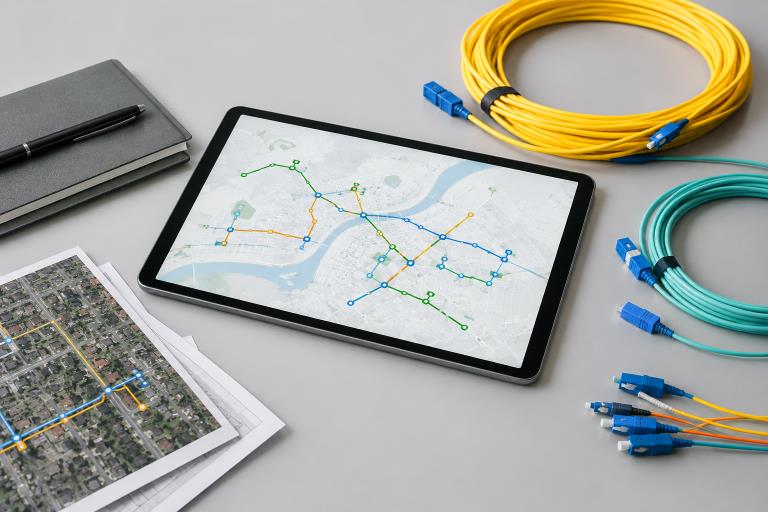
VETRO FiberMap is the core environment for planning, designing, building, and operating a fiber network. Teams can use it to document routes, network structures, equipment, connections, and physical assets while maintaining a visual view of the network.
Rather than relying on isolated files that circulate among departments, FiberMap can provide engineering, operations, construction, and leadership teams with a shared workspace. That structure can support practical activities such as network expansion planning, cost and revenue estimation, proposal development, service-gap analysis, construction tracking, and inventory documentation. A visual network context can be useful when teams need to trace how a proposed extension relates to existing infrastructure, identify dependencies between components, or review the potential operational effect of a design revision.
How Can VETRO Support Engineering Firms?
Engineering firms need a disciplined process for revisions, reviews, and deliverables, particularly when multiple stakeholders contribute to a project. VETRO provides a central workspace where designs can be reviewed and updated without depending solely on disconnected files. One VETRO customer testimonial describes the platform as a source of truth for fiber circuit splicing and physical fiber assets. That is a customer-reported experience, not a guaranteed outcome for every deployment. Engineering teams should still define review responsibilities, naming conventions, approval steps, and deliverable requirements so that the platform supports an established quality-control process rather than becoming another location for ungoverned information.
How Does VETRO Mobile Improve Field-to-Office Coordination?
Field crews often work in areas with limited connectivity, while office teams need timely updates to keep designs and documentation current. VETRO Mobile is built to connect those workflows with field access to network data, offline capture capabilities, and structured change management.
- Limited job-site connectivity: Offline access allows crews to capture information in locations where a live connection is unavailable.
- Delayed drawing updates: Field drawings, notes, photos, and sketches can be submitted for review rather than waiting for manual file transfers.
- Unclear construction changes: Centralized change sets can help office and field users review redlines and updates against the same network context.
Location: VETRO, Inc. | 12 Mountfort Street, Suite 401, Portland, ME 04101 | +1 (207) 221-6627
Faster information flow does not eliminate the need for quality control, but it can shorten review cycles and help the operational record better reflect actual field conditions. Teams can further improve consistency by establishing which details must accompany a field update, who reviews submitted changes, and when an approved change becomes part of the authoritative network record.
How Does VETRO Turn Network Data Into Business Value?
Network visibility also has a commercial dimension. VETRO Z-Manager is designed to help teams visualize demand data alongside the network, enabling operators to identify service gaps, evaluate prospective build areas, and coordinate network plans with sales and marketing activities.
Operators can use this foundation to support market expansion decisions, pre-registration efforts, demand analysis, take-rate initiatives, and proposal development. The platform does not replace financial modeling or local market validation. Instead, it can provide those analyses with a stronger infrastructure and a location database. For example, a team can use connected location and network information to frame questions about where service is available today, where a planned extension could create additional opportunity, and where address quality should be reviewed before outreach begins.
How Does AddressBook Strengthen Customer and Location Data?
Address quality directly affects service qualification, customer onboarding, billing workflows, and the ability to understand which locations are ready for service. AddressBook is VETRO’s address-data solution, designed to automate address verification and standardization while centralizing records.
This is especially relevant in multi-dwelling units, where a street address may not provide enough detail to identify each serviceable unit. By maintaining more consistent location data across connected workflows, teams can reduce ambiguity between network availability and customer-facing records. A defined process for handling new construction, unit changes, duplicate entries, and incomplete address details can help preserve that consistency over time.
What Broadband Deployment Trends Should VETRO Users Watch in 2026?
Operators continue to plan very-high-capacity network expansion, including full-fiber and gigabit-capable infrastructure. Ofcom’s 2026 broadband deployment statistics examine operators’ stated plans through the end of 2028 and emphasize that future plans may change.
The lesson applies broadly: scalable design practices, current records, and clear collaboration are important because build plans evolve. Organizations need processes that can accommodate additions, revisions, construction changes, and shifting commercial priorities without undermining confidence in the underlying data. This is why records should be reviewed as part of ongoing operations, not only when a construction project reaches a formal milestone.
How Can VETRO Help Public-Sector Broadband Teams?
Public-sector teams can use connected network and location information to support infrastructure planning, grant preparation, project oversight, and stakeholder communication. VETRO has published a customer example involving an ARPA grant application completed in nine days under urgent conditions. That example reflects one reported project experience and should not be interpreted as a universal timeline.
Grant-funded projects still require organizations to follow applicable program rules, procurement obligations, reporting standards, and local policies. Technology can organize data and improve visibility, but it does not replace compliance review or project governance. Public-sector users should also determine early which data must be retained for reporting, which stakeholders need access, and how project updates will be validated before they are shared externally.
How Should a Broadband Operator Evaluate VETRO?
- Identify every current source of network, address, construction, and customer data.
- Document where data becomes delayed, duplicated, incomplete, or difficult to verify.
- Prioritize the workflows creating the greatest operational or commercial friction.
- Assess how FiberMap, Mobile, Z-Manager, and AddressBook align with those needs.
- Set measurable criteria, such as update speed, review time, address accuracy, rework, and project visibility.
- Request a demonstration using examples that reflect the organization’s network type, scale, and team structure.
It is also useful to define a practical starting scope. An operator may begin with one market, project type, construction workflow, or address-quality initiative, then compare the results against a documented baseline. This keeps the evaluation focused on the workflows that matter most and helps leaders distinguish among platform capabilities, process changes, data cleanup needs, and training requirements.
Conclusion
VETRO provides a connected approach to managing fiber design, field activity, address information, operational records, and market opportunity. As broadband networks become larger and more complex, the ability to work from shared, current information becomes a practical advantage. Operators that evaluate VETRO against clear data, deployment, and growth goals can determine whether its platform fits their path from network design to monetization. The strongest evaluation will consider not only the technology itself, but also the organization’s readiness to maintain accurate data, establish accountable workflows, and use connected information in day-to-day decisions.